Where Spatial Computing Meets Spatial intelligence
Book: Virtual Twins and Spatial Computing in Architecture and Urban Design; to be published:2026
Book Summery: Virtual Twins and Spatial Computing in Architecture and Urban Design emerges from the growing need for a structured, interdisciplinary guide that illuminates the evolving convergence of architecture, immersive technology, and intelligent systems. This book is designed for a diverse audience—whether you’re an architect exploring XR-driven design workflows, a data scientist integrating urban IoT systems, or a policymaker shaping the next generation of smart, responsive cities. Rooted in the intersections of architecture, computer science, geospatial analysis, urban planning, and systems engineering, this work seeks to bridge conceptual frameworks with practical applications. It also reflects the culmination of my years of interdisciplinary research, teaching, and real-world collaboration across academia, government institutions, and industry partners. Through this book, I aim to provide both foundational knowledge and forward-looking insights into how spatial computing and digital twins are transforming the built environment.
Welcome to MetaParametric
At MetaParametric.com, we are at the forefront of immersive technology innovation, transforming the fields of architecture and urban design. Harnessing the power of Spatial Computing, Extended Reality (XR), Digital Twins, and cutting-edge Artificial Intelligence, we develop advanced platforms that seamlessly integrate the physical and digital realms—enabling real-time interaction, immersive visualization, and intelligent decision-making.
Our comprehensive expertise covers the full spectrum of architectural and urban technology solutions. From interactive VR learning environments and high-fidelity digital twin visualizations to AI-augmented design workflows and cloud-enabled data integration, we unify BIM, GIS, IoT, and sensor inputs into dynamic, coherent models. These integrated systems support advanced simulations, remote collaboration, and automated monitoring—driving smarter, more sustainable urban development and building management.
Siamak A. Bazzaz PhD | PMP | PMI-ACP | ITIL | Certified Multi-cloud Practitioner | Founder at MetaParametric.com Ln
Research Interests: Spatial Computing Spatial intelligence Cognitive XR Multimodal AI-powered 3D UIs Spatially Intelligent Digital Twins Cloud/Edge AI-powered Computing for XR
The rapid advancement of spatial computing /spatial intelligence is revolutionizing how we understand and interact with physical and virtual environments, enabling unprecedented precision and context-awareness. Cutting-edge multimodal AI-powered 3D user interfaces are emerging as intuitive gateways for immersive experiences, combining voice, gesture, and visual inputs to enhance human-computer interaction. Digital twin platforms have evolved into dynamic, intelligent ecosystems that mirror real-world assets and processes in real time, driving smarter decision-making and operational efficiency. The integration of spatially intelligent digital twins leverages advanced spatial analytics and AI to provide deeper insights and predictive capabilities. Powered by scalable cloud computing and data integration, these platforms can handle vast, heterogeneous datasets essential for complex simulations and real-time updates. The fusion of AI with extended reality (XR) technologies further amplifies these capabilities, enabling immersive visualization, collaboration, and control across industries. Together, these technologies represent the state of the art in creating connected, intelligent, and interactive digital-physical ecosystems with transformative potential.
Understanding the transformative potential of these spatial and intelligent technologies requires placing them within the broader context of technological evolution—tracing how innovations from the Industrial Revolutions to today’s AI-driven era have shaped our current digital landscape.
Beyond [Reality]
We are entering a transformative epoch defined by exponential technological advancement; driven by the forces of Industry 4.0 and rapidly evolving into the human-centric ethos of Industry 5.0. This shift is not merely an upgrade of tools, but a redefinition of how we shape and experience our world.
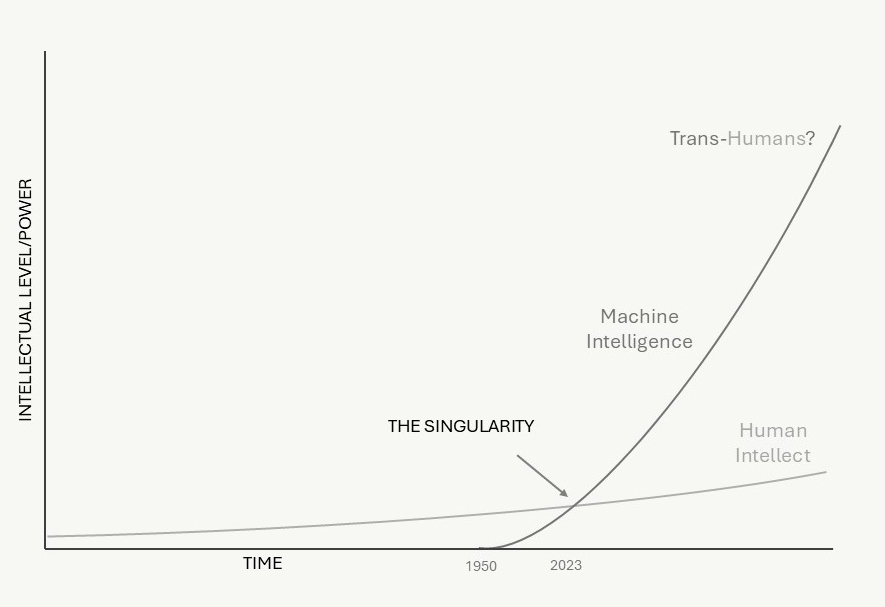
The history of technology is marked by transformative waves of innovation that have reshaped human civilization. Each epoch has brought about profound economic, societal, and cultural shifts, culminating in what many scholars and futurists now describe as an imminent technological singularity—a point where artificial intelligence surpasses human intelligence, triggering exponential and irreversible change.
The foundation of this evolution lies in what Klaus Schwab, founder of the World Economic Forum, classifies as the Four Industrial Revolutions. In his seminal work The Fourth Industrial Revolution (2016), Schwab explains:
“We stand on the brink of a technological revolution that will fundamentally alter the way we live, work, and relate to one another.”
The First Industrial Revolution (late 18th century) harnessed water and steam power to mechanize production.
The Second Industrial Revolution (late 19th and early 20th centuries) introduced electricity and enabled mass production.
The Third Industrial Revolution (mid-20th century) brought electronics and information technology into manufacturing.
The Fourth Industrial Revolution is characterized by a fusion of technologies—AI, robotics, IoT, and quantum computing—blurring the lines between the physical, digital, and biological spheres.
Progression from the First Industrial Revolutionto the Fifth Industrial Revolution
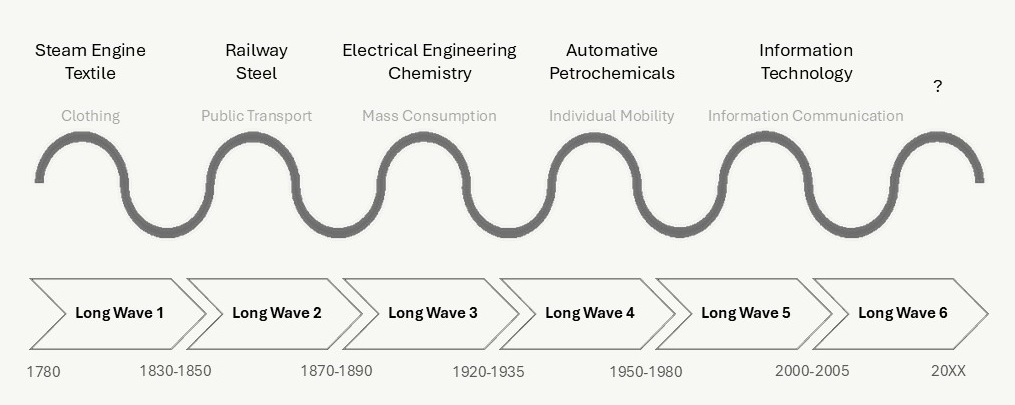
This wave-based model of technological change finds resonance in the economic theory of Kondratiev Waves, introduced by Russian economist Nikolai Kondratiev in the 1920s. Kondratiev proposed that modern capitalist economies experience long-term cycles of boom and bust, typically spanning 40 to 60 years, driven by clusters of technological innovations. Each wave has been accompanied by a new technological paradigm: steam engines, railways, electricity, mass production, and now digital and AI technologies.
Kondratiev Waves (Nikolai Kondratiev)
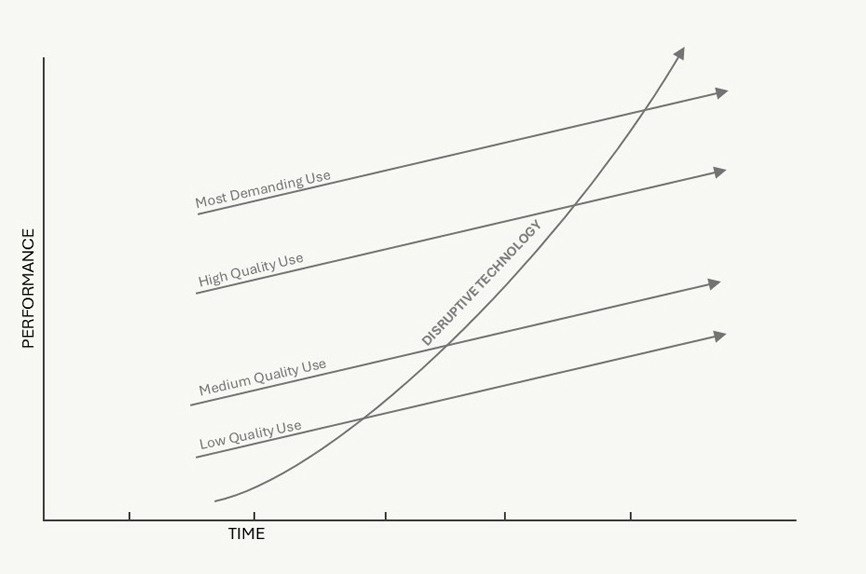
Adding a layer of nuance, Clayton Christensen introduced the concept of disruptive innovation in his influential book The Innovator’s Dilemma (1997). He described how smaller firms with fewer resources can successfully challenge established businesses by targeting overlooked segments and deploying simpler, more affordable technologies. Christensen noted:
“Disruptive technologies typically enable new markets to emerge. By the time mainstream customers demand the features of the new technology, it is often too late for the incumbent to catch up.”
Disruptive Innovation (Clayton Christensen)
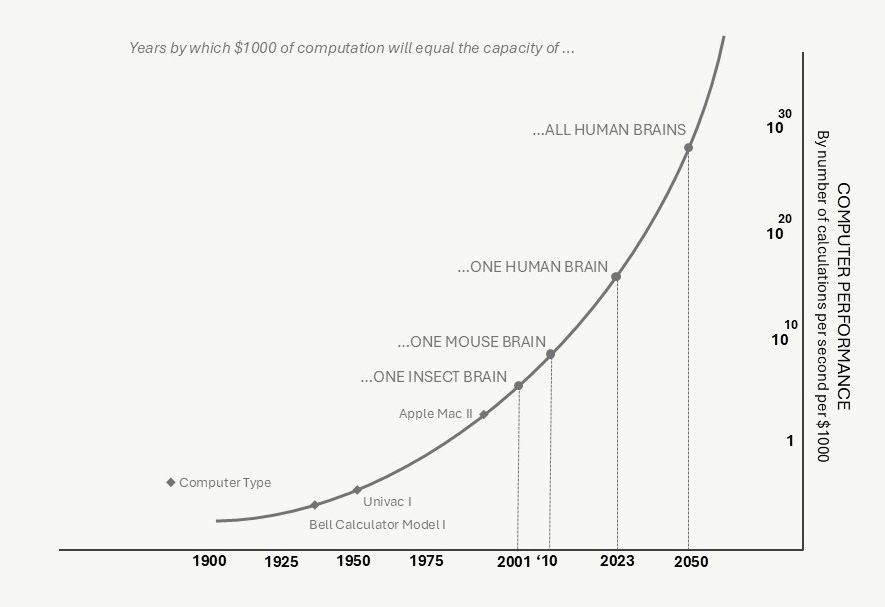
The exponential trajectory of such innovations is elegantly illustrated by Ray Kurzweil through what is now known as the Kurzweil Curve. This framework, derived from his work in The Singularity Is Near (2005), predicts accelerating returns in technological development, especially in computing power, AI, and biotechnology. Kurzweil argues:
“Our intuition about the future is linear. But the reality of information technology is exponential.”
According to Kurzweil, we are rapidly approaching a technological singularity, likely within the 21st century, when non-biological intelligence will exceed human intellectual capacity and control.
Together, these theories and perspectives reveal a consistent pattern: technological evolution is not a linear continuum but a series of overlapping revolutions and disruptions. As we navigate the complexities of the Fourth Industrial Revolution and anticipate the coming singularity, understanding the historical rhythms and theoretical frameworks—from Kondratiev’s economic cycles to Kurzweil’s exponential vision—is essential for architects, designers, entrepreneurs, and policymakers alike.
Complementing these perspectives are foundational theories that deepen our understanding of technological transformation. Moore’s Law, formulated by Gordon Moore in 1965, observes that the number of transistors on a microchip doubles approximately every two years, driving exponential growth in computing power—a trend that has fueled modern digital advancements. This phenomenon aligns with the rise of exponential technologies, which evolve rapidly and disruptively, often outpacing regulatory and societal adaptation. Economist Joseph Schumpeter introduced the concept of creative destruction, emphasizing how innovation continually dismantles old structures to make way for new economic paradigms. Central to this process are General Purpose Technologies (GPTs)—such as electricity, the internet, and AI—which have broad and transformative impacts across multiple industries. These developments are often framed within the theory of technological determinism, which posits that technological innovation is the primary driver of societal change, shaping institutions, behavior, and culture in its wake.
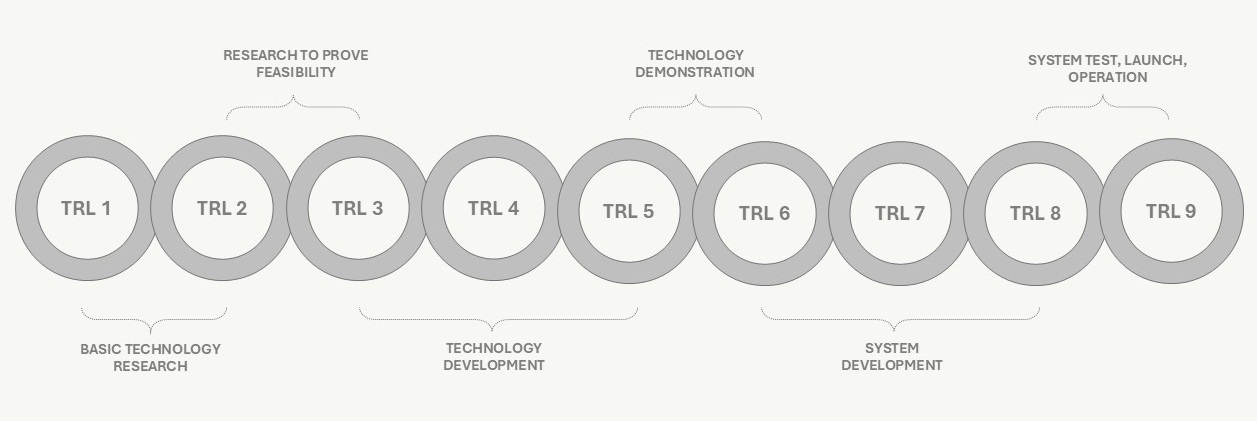
Modern technological evolution cannot be understood in isolation from its social context, giving rise to the concept of socio-technical systems—frameworks that examine the interdependent relationship between people, technology, and organizational structures. This holistic view is essential in the era of digital transformation, where businesses and institutions are reengineering processes, models, and cultures through digital technologies. A key enabler of this transformation is the emergence of cyber-physical systems (CPS), which tightly integrate computational algorithms with physical processes, forming the backbone of Smart Manufacturing and Industry 4.0. These intelligent systems facilitate real-time monitoring, predictive maintenance, and adaptive production environments. However, the successful deployment of such innovations hinges on their technology readiness levels (TRLs)—a framework that assesses how mature and deployable a technology is, from concept to full-scale operation. Likewise, the pace of technology adoption varies across sectors and is influenced by factors such as organizational culture, user readiness, infrastructure, and policy support. At the core of this new industrial paradigm lies human-machine collaboration, where humans and advanced technologies—such as robots, AI, and immersive interfaces—interact symbiotically to enhance decision-making, creativity, and operational efficiency. As readiness and adoption accelerate, the fusion of human and technological capabilities promises unprecedented advances in productivity and innovation.
Technology Readiness Levels (TRLs)
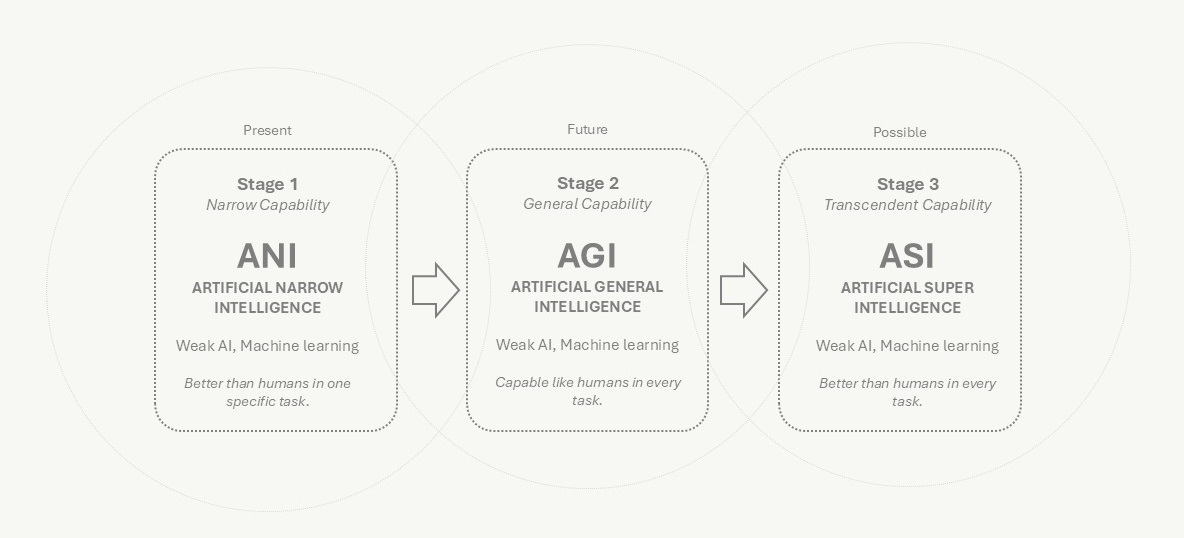
Building on the foundation of innovation theory, Neo-Schumpeterian economics extends Schumpeter’s ideas by emphasizing the role of knowledge, technological innovation, and institutional change in driving long-term economic dynamics. In this evolving landscape, computational paradigms like edge computing and cloud computing have become critical infrastructures, enabling decentralized data processing and scalable access to AI and digital services. These technologies are paving the way toward Artificial General Intelligence (AGI)—a future form of AI capable of understanding, learning, and reasoning across domains at a human level or beyond. As these capabilities advance, they reflect the shift described by sociologist Daniel Bell in his theory of the post-industrial society, where knowledge, information, and services surpass industrial production as the central drivers of economic value. This transition also underpins the rise of the platform economy, where digital platforms like Amazon, Google, and Airbnb orchestrate vast ecosystems of users and services, redefining market structures, labor, and value creation.
Types of Artificial Intelligence
The accelerating pace of innovation is increasingly driven by technological convergence, where formerly distinct fields—such as biotechnology, artificial intelligence, and telecommunications—merge to create novel capabilities and disruptive solutions. This interconnectedness is reflected in Metcalfe’s Law, which posits that the value of a network increases exponentially with the number of connected users, reinforcing the power of digital ecosystems and collaborative platforms.
Metcalfe’s Law
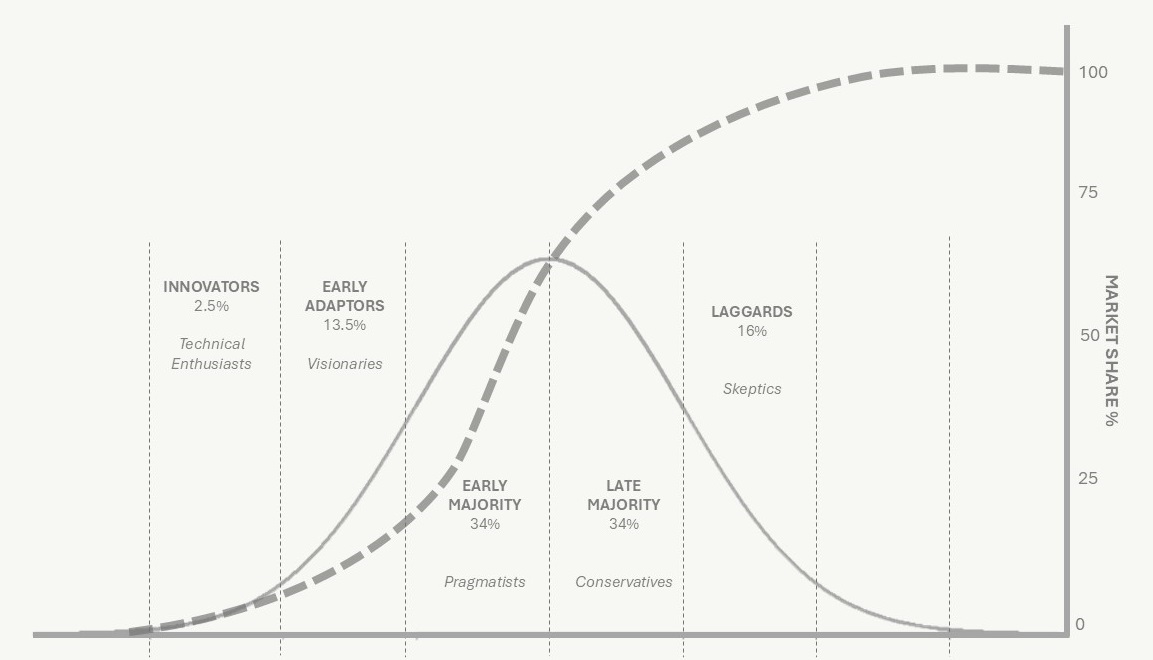
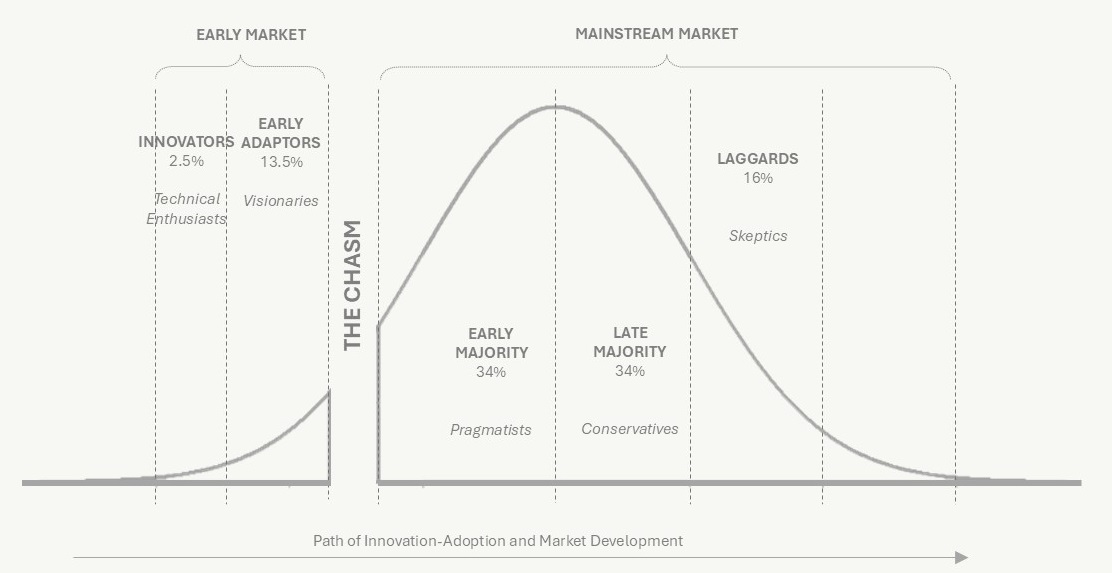
Understanding how new technologies spread within societies is essential, as explored in Everett Rogers’ Diffusion of Innovations theory, which categorizes adopters into innovators, early adopters, early majority, late majority, and laggards, highlighting the social dynamics of technological acceptance. Broader historical shifts in generational behavior and societal values are captured by the Fourth Turning, a theory by Strauss and Howe, which describes recurring 80- to 100-year cycles of crisis and renewal driven by generational archetypes. As societies navigate these cycles and disruptions, societal resilience and adaptation become critical—requiring flexible systems, forward-thinking policies, and inclusive innovation to withstand and thrive amid technological, environmental, and cultural upheavals.
Everett Rogers’ Diffusion of Innovations theory (1962)Geoffrey Moore’ Technology adoption life cycle (1991)AI+XR Integration
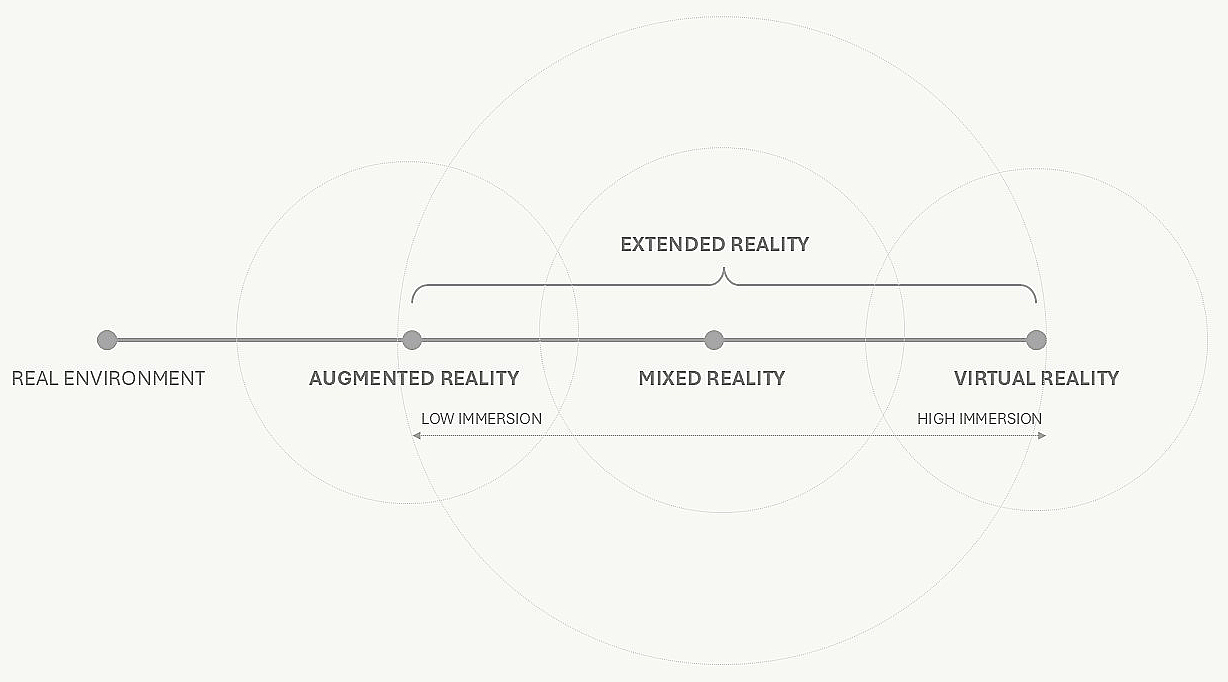
Originally proposed by Milgram and Kishino (1994), the Reality–Virtuality Continuum illustrates the dynamic spectrum between the real world and fully immersive Virtual Reality (VR). In between lies Mixed Reality (MR)—a space where physical and digital elements interact—and Augmented Reality (AR), where virtual content is layered onto the real environment. These immersive technologies are collectively referred to as Extended Reality (XR), which encompasses AR, MR, and VR under one unified framework.
Milgram and Kishino’s Reality-Virtuality Continuum
The integration of AI and XR is rapidly reshaping the future of human-computer interaction. As XR technologies become more intelligent, we are entering a new era of Cognitive XR, where immersive environments respond proactively to users through AI-powered perception, reasoning, and adaptation. From generative VR worlds that co-create environments with users, to AI-personalized learning in VR, and spatially-aware conversational AR agents on smart glasses, AI is enabling immersive experiences that are increasingly autonomous, responsive, and context-aware. Future trajectories include agentic digital twins, multi-agent MR collaboration, and semantic AR interfaces, unlocking vast potential in design, education, healthcare, and enterprise applications.
Historically, XR has evolved over decades. Morton Heilig’s Sensorama (1962) and Ivan Sutherland’s Sword of Damocles (1968) are often cited as early precursors to modern VR. Tom Caudell coined the term Augmented Reality in the 1990s, while Paul Milgram and Fumio Kishino laid the theoretical groundwork for Mixed Reality. Major commercial strides came in the 2010s with Oculus Rift (acquired by Meta), Microsoft HoloLens, and Magic Leap One, ushering in consumer and enterprise-grade XR.
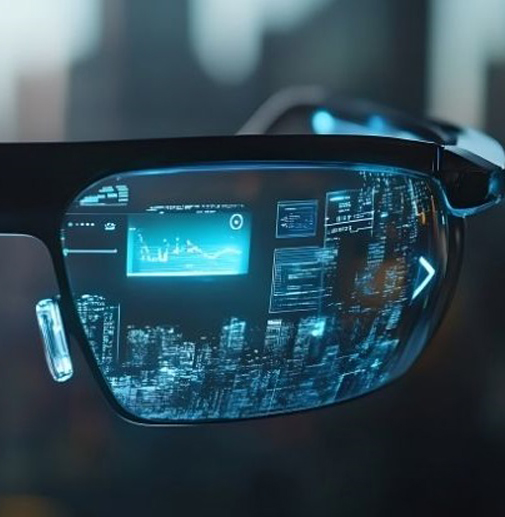
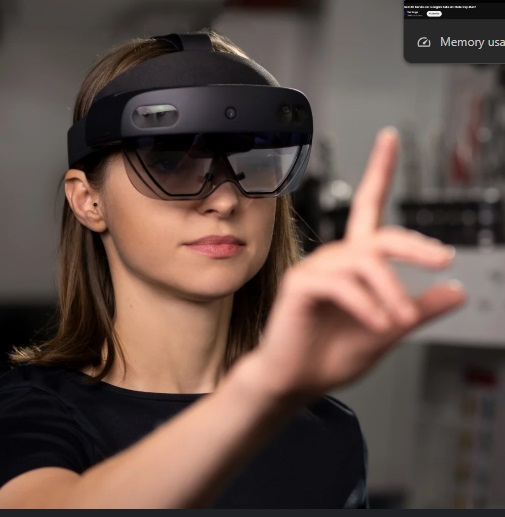
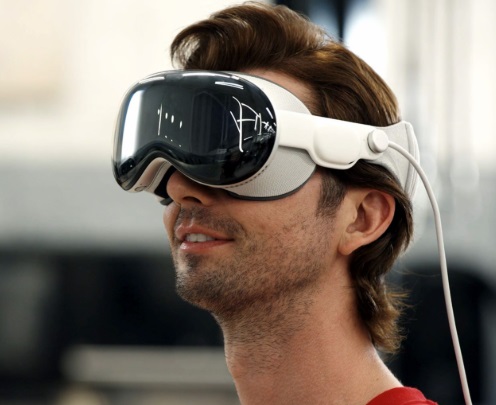
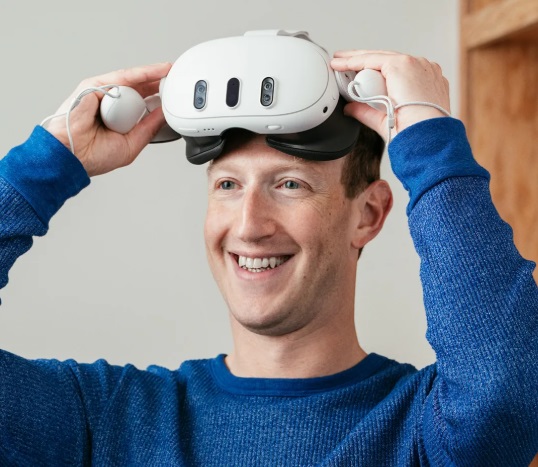
Today, key devices in the market include the Meta Quest 3, Apple Vision Pro, Microsoft HoloLens 2, Magic Leap 2, and Meta Ray-Ban AI Glasses, alongside emerging platforms like Google Android XR and Meta Orion. These systems increasingly embed multimodal AI capabilities—voice, vision, gesture, and intent recognition—setting the stage for the next frontier: intelligent, embodied, and symbiotic XR systems that seamlessly blend physical and digital realities.
[potential] AI+VR Integration
[potential] AI+AR Integration
[potential] AI+MR Integration
Cognitive VR
AI Glasses with Real-Time Contextual AI
Embodied AI Agents in MR
Generative VR Worlds
Spatially-Aware Conversational AI
Generative Co-Design in MR
Conversational Agents in VR
Generative AR Content
Agentic Twins in MR
AI-Personalized VR Learning
Hands-Free Intelligent Interfaces
Multi-Agent Collaboration
AI-powered 3D user interfaces
Semantic AR Layering
Sensor-Aware Immersive AI
Autonomous VR Interfaces
Conversational AR
Adaptive Task Guidance in MR
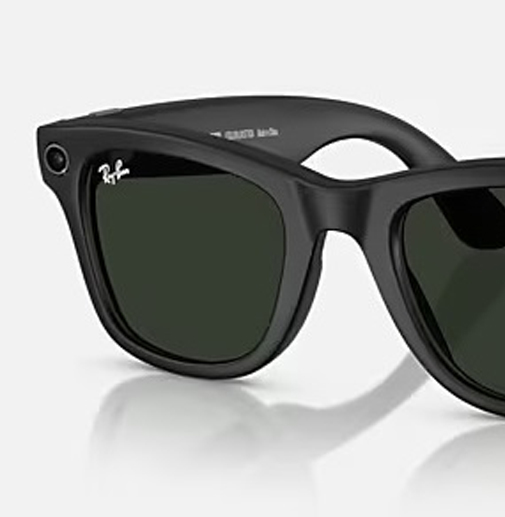
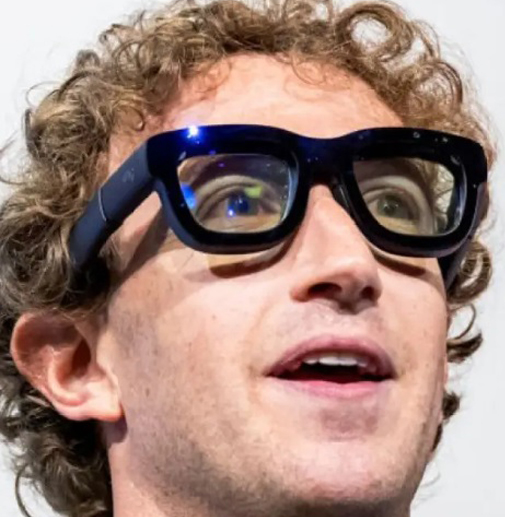
Smart Glasses and XR Headsets (June 2025)Ray-Ban Meta Wayfarer AI GlassesMeta’ Orion AR GlassesGoogle Android XR GlassesMicrosoft HoloLens2Apple Vision ProMeta Quest 3
Feature / Device
Ray-Ban Meta Glasses
Meta Orion (Project Orion)
Google Android XR Glasses
Apple Vision Pro
Microsoft HoloLens
Meta Quest 3
Status
Available
In development (2026+)
Prototype stage
Available (US only)
Available
Available (since 2023)
Display
None
AR/MR display (planned)
AR display (planned)
Full Mixed reality
Mixed reality
MR display (color passthrough)
AI Assistant
Meta AI (voice+vision)
Meta AI multimodal
Gemini AI multimodal
Siri + ML apps
Azure AI integration
Voice + hand; Meta AI (basic)
Spatial Computing
No
Yes
Yes
Yes (best-in-class)
Yes
Yes (room mapping, anchors)
Hand/Eye/Voice Tracking
Limited (voice only)
Expected full support
Expected full support
Full support
Full support
Hand tracking, partial eye
Camera
12MP photo/video
Advanced (expected)
Expected
3D cameras/LiDAR
RGB + depth
Depth + RGB passthrough
SDK / Dev Tools
None or limited
Full (Meta XR SDK)
Android XR SDK
visionOS SDK
Mixed Reality Toolkit
Meta SDK + OpenXR
Platform / OS
Meta OS (custom)
Meta Android XR (expected)
Android XR
visionOS
Windows Holographic
Meta Quest OS (Android-based)
Cloud Integration
Meta Cloud
Meta + OpenXR
Google Cloud + Firebase
iCloud + CloudKit
Azure Cloud (strong)
Meta + third-party options
Best Use Case (Now)
AI assistant, POV camera
N/A (future XR + AI agent)
N/A (future XR/AI)
Design reviews, 3D UX
Industrial BIM, inspection
Immersive VR/XR apps, prototyping
Best Use Case (Future)
–
AI-powered AR, spatial agents
Immersive AI assistants
XR collaboration
Digital Twin workflows
Mixed reality collaboration
Form Factor
Glasses (very light)
Glasses-like (planned)
Glasses (planned)
Headset (bulky)
Headset (semi-bulky)
Headset (compact VR/MR)
Price
~€330
TBD (likely ~$1,000+)
TBD
$3,499
~$3,500+
$499–$649
Smart Glasses and XR Headsets
Emerging breakthroughs driving the AI+XR in the future
Multimodal Generative AI in 3D Space: The ability to create immersive worlds, objects, and interactive environments from natural language commands—enabling designers to generate complex spaces simply by describing them.
Agentic AI in XR: Intelligent virtual assistants embedded within AR/VR environments that collaborate, guide, and co-design alongside architects and urban planners, providing real-time insights on performance, sustainability, and user experience.
Spatially-Aware AI: AI systems that perceive and understand the physical environment in real time through smart glasses and XR devices, enabling contextually relevant augmented overlays and seamless interaction with both digital and real-world elements.
AI-Enhanced Digital Twins: Living digital models that autonomously monitor, predict, and optimize building and city operations, visualized in immersive environments for smarter management and decision-making.
AI-Powered Natural Interaction in XR: Advanced multimodal interfaces combining gesture, gaze, voice, and intent prediction to enable intuitive, hands-free control and conversational interaction within spatial computing platforms.
Edge AI Combined with Cloud XR: Hybrid architectures where on-device AI delivers low-latency experiences while cloud computing provides robust data processing and collaboration, seamlessly integrating wearable XR devices with intelligent infrastructure.
AI-Driven Immersive Experience Design: Exploring how generative AI and large language models can create adaptive, context-aware XR environments tailored to user needs and preferences.
Human-Centered XR Hardware Design Integrating advanced AI capabilities with cutting-edge wearable design principles for seamless, lightweight, and socially acceptable smart glasses and headsets.
Ambient Intelligence in XR Spaces: Developing intelligent environments that proactively respond to users through voice, gesture, and biometric inputs, enhancing immersion and productivity.
Conversational AI for XR Interaction: Designing natural language interfaces powered by LLMs that allow hands-free, intuitive interaction within AR/VR/MR environments.
AI-Augmented Spatial Computing: Combining spatial mapping (LiDAR, SLAM) with AI-driven scene understanding to enable smarter object recognition, real-time environment adaptation, and predictive modeling.
Next-Gen XR UI/UX with AI Co-Creation: Leveraging AI to dynamically generate and adapt 3D user interfaces and immersive workflows in architecture and urban design.
Generative AI for Virtual World Creation: Using AI to automatically generate architectural forms, urban layouts, and environmental simulations within immersive platforms.
Ethical and Human-Centric AI Design in XR: Investigating frameworks to ensure responsible, privacy-conscious AI use in spatial computing and immersive environments.
AI-Powered AR Remote Assistance: Developing AR systems that enable remote experts (architects, engineers, consultants) to guide on-site teams through voice, gesture, and AI-annotated overlays—facilitating real-time issue detection, design validation, and construction monitoring.
Context-Aware AR Assistants: Creating intelligent AR agents that understand spatial context (BIM data, site conditions) to assist architects and designers remotely—providing guidance, checking compliance, or suggesting design alternatives in real time through wearable devices like smart glasses.
Emerging breakthroughs driving the AI+XR in the future
Spatial Computing
Spatial computing refers to the technologies that allow computers to interact with, understand, and manipulate the space around us. It blends the physical and digital worlds using sensors, location data, 3D mapping, computer vision, and spatial awareness. Devices like AR glasses, LiDAR-equipped phones, and VR headsets use spatial computing to:
Recognize and track objects, people, and environments
Anchor digital content in physical space
Enable natural interactions via gestures, gaze, or movement
Spatial computing powers applications such as AR navigation, digital twin visualization, robotics, autonomous vehicles, and immersive training environments.
Immersive design refers to the creation of environments, experiences, and interfaces that fully engage users through extended reality (XR). It involves designing 3D spaces—often interactive—where users can move, explore, and engage with digital content as if it were part of the real world. This includes:
Architectural walkthroughs in VR
AR overlays for urban planning or engineering
Spatial UI/UX for smart glasses or mixed reality applications
Immersive design combines spatial computing, storytelling, and human-centered interaction to create emotionally resonant, intuitive experiences.
The shift from spatial computing to spatial intelligence represents a transition from sensing and mapping space to understanding and reasoning about it.
Spatial Computing: The system knows where things are (mapping, tracking, anchoring).
Spatial Intelligence: The system knows what things are, how they relate, and what to do about them (interpreting context, predicting behavior, autonomous decision-making).
In practice, spatial intelligence leverages AI + spatial computing to create environments where systems can proactively interact with humans and surroundings—this is foundational for Symbiotic Digital Twins, smart environments, and cognitive XR systems.
Aspect
Spatial Computing
Spatial Intelligence
Core Function
Understanding where things are
Understanding what things are, how they relate, and what to do about them
Like a guide who knows what everything means and what you should do next
Comparative Framework: Spatial Computing and Spatial Intelligence in XR Systems
Extended Reality (XR) and Digital Twins (DT) are distinct yet complementary technologies that often converge in advanced digital ecosystems. XR is an umbrella term that includes Augmented Reality (AR), Virtual Reality (VR), and Mixed Reality (MR), and is primarily focused on delivering immersive, interactive experiences. It enables users to engage with spatial digital content through headsets, glasses, or mobile devices, often enhancing visualization, design, training, and collaboration. In contrast, Digital Twins are dynamic virtual representations of real-world assets, systems, or processes, continuously updated through data from sensors, IoT devices, or simulations. While XR centers on how humans perceive and interact with digital information, Digital Twins focus on how systems monitor, simulate, and optimize physical operations. XR provides the interface for experiencing and navigating complex data, whereas Digital Twins provide the intelligent backend, capable of analytics, decision-making, and predictive modeling. When combined, XR and DT create powerful tools for immersive operations—allowing users to step inside data-rich environments, interact with live systems, and make informed decisions in real time.
Spatial Intelligence
Among the emerging domains highlighted in the World Economic Forum’s 2025 Technology Convergence Report, Spatial Intelligence stands out as a transformative field reshaping how humans and machines understand, navigate, and interact with the physical world.
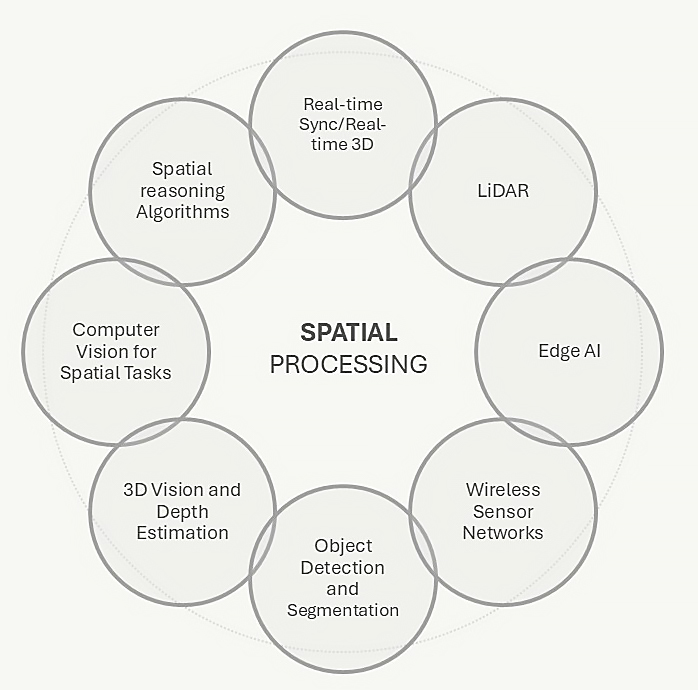
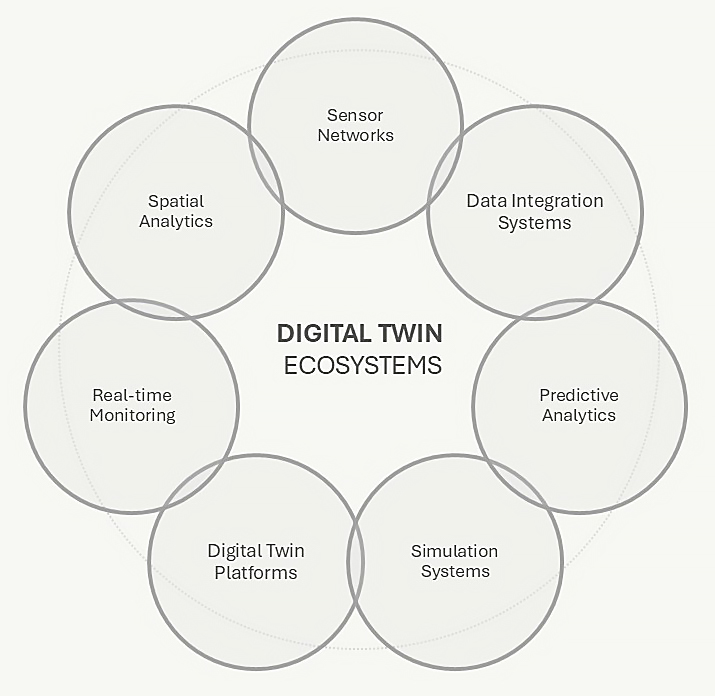
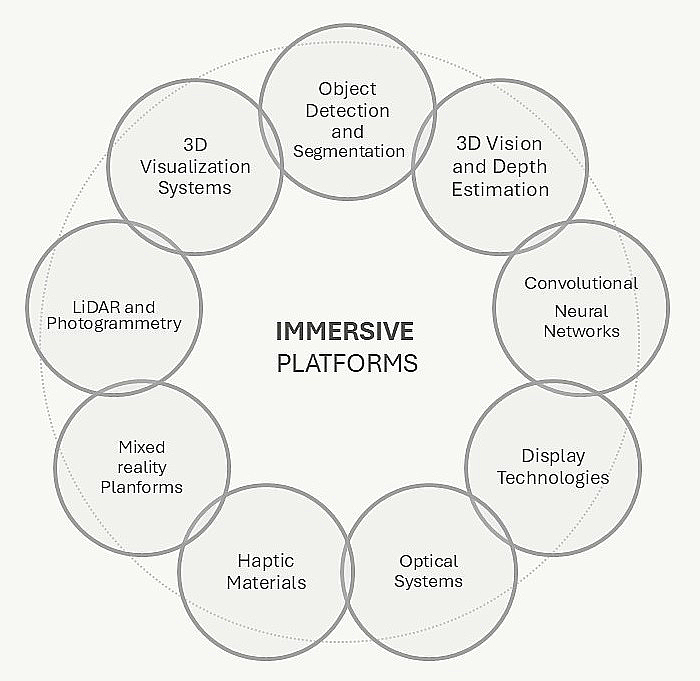
Spatial intelligence marks a foundational transformation in how physical environments are perceived, analyzed, and interacted with—blurring the lines between digital and physical realms. Enabled by the convergence of digital twin ecosystems, immersive platforms, and spatial processing, this domain empowers simulation, monitoring, and collaboration within richly contextual virtual environments. At its core, spatial intelligence relies on cutting-edge technologies such as high-resolution LiDAR, 3D vision, and edge analytics to generate real-time, millimeter-accurate spatial data. These tools enable everything from robotic alignment in smart manufacturing to urban simulation for infrastructure resilience. Immersive platforms, powered by spatial computing engines and mixed reality systems, create environments where digital content is precisely anchored and contextually relevant—enhancing workflows in aerospace, precision surgery, and advanced training. Meanwhile, digital twin ecosystems integrate IoT sensors, AI-driven simulation, and predictive analytics to replicate and optimize complex systems in real time. These ecosystems are evolving into “internets of twins”—networks of interconnected digital replicas that exchange operational insights and autonomously drive optimization. As investments grow in haptic feedback, spatial AI, and standardization of spatial computing protocols, spatial intelligence is not only reshaping industries but also driving a deeper, more intuitive form of human-machine-environment collaboration.
Spatial Intelligence Components are:
Spatial Processing:Real-time analysis and interaction with 3D environments using LiDAR, computer vision, and edge analytics.Digital Twin Ecosystem:A dynamic virtual replica of physical systems powered by IoT, simulations, and AI-driven analytics. Immersive Platforms:Mixed reality environments that seamlessly blend digital content with the physical world for intuitive interaction.
As global connectivity evolves from 4G to 5G and soon 6G, ultra-fast, low-latency networks are enabling real-time communication between people, devices, and intelligent systems. At the core of this evolution are disruptive technologies: Artificial Intelligence (AI), Generative AI, Large Language Models (LLMs), cloud computing, and automation—powerful forces that are fundamentally reshaping the way we design, create, collaborate, and live.
For architects and urban designers, this convergence opens a new frontier. The rise of data-rich environments and parametric design workflows has already laid the foundation. Now, with the integration of AI into immersive platforms such as XR, Digital Twins, and smart wearable devices like Meta Ray-Ban smartglasses, Meta Orion, and Google’s Android XR Glasses—we are witnessing the emergence of intelligent, responsive environments.
Cloud/Edge AI-powered Computing for XR
The convergence of cloud computing, edge AI, and extended reality (XR) technologies is fundamentally reshaping how immersive environments are developed, deployed, and experienced. As XR applications increasingly demand high performance, ultra-low latency, and dynamic contextual adaptation, the integration of distributed computing paradigms becomes essential.
Cloud computing provides a scalable backbone for XR systems by offering virtualized infrastructure, platform services, and AI capabilities through centralized data centers. Services such as Amazon Web Services (AWS), Microsoft Azure, and Google Cloud Platform enable XR developers to offload intensive computational tasks—including real-time 3D rendering, AI model training, and large-scale simulation—to the cloud. The elasticity and resource abstraction inherent to Infrastructure as a Service (IaaS), Platform as a Service (PaaS), and Software as a Service (SaaS) paradigms allow for responsive scaling of XR environments, global content delivery, and cross-platform compatibility.
In immersive applications such as multi-user VR collaboration platforms, cloud computing enables synchronized digital twins, persistent virtual spaces, and shared AI agents. These capabilities are essential for sectors such as architecture, healthcare, urban planning, and education, where high-fidelity XR experiences are paired with real-time data feeds and AI-driven feedback loops.
While cloud computing offers scale and centralization, Edge AI shifts computation closer to the data source—on devices such as AR glasses, mobile phones, smart sensors, or autonomous drones. This paradigm is critical for latency-sensitive XR applications such as on-site augmented inspection, real-time object recognition, spatial analytics, and interactive gaming.
By enabling AI inference at the edge, systems can:
Reduce latency, crucial for real-time interaction and spatial anchoring in AR/VR
Enhance data privacy, ensuring sensitive spatial or biometric data remains local
Support intermittent connectivity, facilitating functionality in remote or infrastructure-poor environments
Optimize bandwidth, by filtering, summarizing, or pre-processing data before cloud synchronization
Recent advances in edge accelerators (NVIDIA Jetson, Apple Neural Engine) and AI model compression techniques (quantization, pruning, federated learning) have made it increasingly feasible to deploy sophisticated computer vision and NLP models directly on XR headsets or companion devices.
The integration of Artificial Intelligence with both cloud and edge architectures yields a synergistic computing model for XR. AI agents, trained on massive cloud-based datasets, can be deployed locally for on-device inference, while feedback and telemetry data collected at the edge can be periodically used to refine models in the cloud (via federated learning).
This hybrid architecture supports emerging use cases such as:
Autonomous digital twins, dynamically updated with sensor data and AI-driven behavior simulation
Semantic scene understanding, where XR systems interpret and respond to real-world environments using computer vision and natural language models
Context-aware assistants, capable of spatial reasoning and task automation based on user interaction in physical-digital spaces
A critical enabler for this ecosystem is data integration—the unification of heterogeneous data sources (sensor streams, BIM models, geospatial datasets, user inputs) into coherent, accessible representations. This involves modern ETL pipelines, APIs, data lakes, and semantic middleware, which must operate in real time to support synchronized visualization and decision-making across XR applications.
Looking ahead, the future of cloud/edge AI-powered XR computing is defined by several key architectural trends:
Intelligent Data Lakes: Unified repositories where multimodal data (3D, spatial, IoT, textual) is contextually indexed and accessible to AI agents.
Autonomous Cloud Pipelines: Self-optimizing workflows for training, deploying, and updating XR components and AI services.
Real-Time Digital Twin Platforms: Live, interactive replicas of physical environments enriched with analytics and immersive overlays.
Federated Learning and Multi-Cloud AI Orchestration: Distributed training and deployment across organizational boundaries, enhancing personalization and scalability.
Cloud-native Agentic Systems: Conversational and task-oriented AI agents operating across cloud services, enabling natural interfaces in XR.
Data Mesh and Semantic Integration: Decentralized and interoperable data architectures supporting XR interoperability across domains and devices.
These innovations pave the way for immersive, intelligent, and contextually responsive XR systems, transforming domains such as smart cities, industrial automation, telemedicine, and education.
The comparison between Cloud AI and Edge AI computing for XR highlights their complementary roles in delivering intelligent extended reality experiences. Cloud AI offers vast computational power, large-scale data storage, and advanced model training capabilities, making it ideal for high-resolution rendering, global data access, and collaborative digital twin environments. It enables scalable services like federated learning, semantic search, and multi-cloud orchestration. In contrast, Edge AI focuses on real-time, low-latency processing at the device level—such as on smart glasses or XR headsets—enabling rapid response, enhanced privacy, and offline functionality. It supports tasks like gesture recognition, spatial mapping, and voice command processing without constant cloud connectivity. Together, they form a hybrid XR architecture where the cloud powers intelligence at scale and the edge ensures immediate, context-aware responsiveness.
Aspect
Cloud AI Computing for XR
Edge AI Computing for XR
Location of Computation
Centralized data centers (AWS, Azure, Google Cloud)
On-device or near the data source (AR glasses, smartphones, IoT devices)
Latency
Higher latency due to network transmission
Ultra-low latency; real-time response critical for XR
Scalability
Highly scalable for compute-intensive tasks (training, rendering, simulations)
Limited by local hardware capabilities
Data Privacy
Data is transmitted to the cloud, raising concerns in sensitive applications
Enhanced privacy as data is processed locally
Connectivity Requirement
Requires stable, high-bandwidth internet
Can operate offline or in low-connectivity environments
Power Consumption
Offloaded from end-user devices; energy usage is handled in cloud infrastructure
Device-dependent; may impact battery life and thermal limits
Use Case Examples
Cloud-rendered VR scenes AI training for spatial analytics Global digital twins
Real-time AR object recognition Voice commands in AR glasses Local spatial mapping
AI Model Deployment
Complex, large models trained and hosted centrally
Optimized, lightweight models (quantized, pruned) for on-device inference
Update and Maintenance
Easier to update and manage models at scale
Updates require OTA (over-the-air) pushes to distributed devices
Cost Structure
Pay-as-you-go based on usage (compute, storage, bandwidth)
Cloud-based synchronization and global collaboration
Local sensor fusion and real-time interaction
Ideal Application Contexts
Multi-user VR worlds Smart city platforms Remote expert systems
On-site maintenance Field inspections Mobile AR navigation
Comparison of Cloud AI and Edge AI Computing for XR
Cloud AI computing excels in scalability, centralized processing, and global orchestration—ideal for heavy computation, training, and persistent digital twin environments. Edge AI computing shines in responsiveness, privacy, and offline capability—critical for real-time, context-aware XR experiences. Ahybrid cloud-edge architecture is often optimal for immersive systems, leveraging the strengths of both paradigms.
Data Integration for XR Computing
In the era of Extended Reality (XR), effective data integration forms the backbone of intelligent, responsive, and context-aware immersive systems. XR applications—ranging from architectural visualization and industrial maintenance to environmental monitoring and telemedicine—depend on real-time, multimodal data fusion to deliver meaningful spatial experiences. This necessitates a robust pipeline capable of ingesting, processing, aligning, and delivering heterogeneous data from both static and dynamic sources.
Data Acquisition
Data acquisition is the foundational phase of the XR data integration pipeline, involving the collection of multimodal data from various physical and digital environments. This phase determines the quality, accuracy, and contextual relevance of immersive experiences in XR applications.
Use Cases: Spatial tracking, object detection, environmental scanning.
IoT / IoRT Devices
Devices: Wearables, smart meters, robotics, medical implants.
Use Cases: Remote health monitoring, industrial telemetry, urban sensing.
Laser Scanning
Devices: High-precision terrestrial laser scanners like the Trimble X9, Leica RTC360, or Faro Focus.
Use Cases: Capturing detailed 3D geometry of built environments, archaeological sites, or infrastructure for XR integration.
Strengths: Sub-centimeter accuracy, dense point clouds for digital twins, seamless import into BIM or GIS platforms for XR overlay.
Photogrammetry and 360° Imaging
Devices: 360° cameras such as the Insta360 X3, GoPro Max, or Ricoh Theta Z1.
Use Cases: Scene reconstruction, virtual tours, immersive walkthroughs, remote inspection.
Strengths: Rapid capture of textured environments; combined with SfM (Structure-from-Motion) software to generate photorealistic 3D meshes for AR/VR.
Smart Glasses and XR Headsets
Devices: Meta Ray-Ban, Apple Vision Pro, Microsoft HoloLens 2, Meta Quest 3, Android XR glasses.
Use Cases: Continuous acquisition of spatial mesh, gestures, gaze, voice, and contextual audio/video from user interactions.
Strengths: Seamless real-time acquisition from user perspective; integration into live spatial computing workflows.
Remote Sensing and Satellite Data
Sources: ESA Copernicus, NASA EarthData, NOAA, commercial providers.
Use Cases: Environmental monitoring (e.g., flood risk, land use, air quality), climate modeling, disaster response.
Strengths: Macro-scale data acquisition for GIS-XR hybrid platforms, enabling context-aware overlays on global or regional maps.
Manual Input and Enterprise Systems
Sources: Databases, BIM/CAD files, GIS datasets, patient records, construction logs.
Use Cases: Initial data population, semantic enrichment, digital twin initialization.
Data Processing and Preprocessing
Cleaning, transforming, and structuring the raw data for semantic understanding and downstream analysis.
Key operations include:
Noise filtering and normalization
Timestamp synchronization
Coordinate transformation
Compression for edge delivery
Data Fusion and Integration
Multiple data streams are aligned and unified into a coherent, multi-layered representation.
Involves:
Spatial alignment (AR overlays on physical environments)
Semantic understanding (AI identifying key objects or areas)
Sensor fusion (combining gaze, gesture, and environment data)
In collaborative XR applications, real-time fusion of speech, gestures, annotations, and shared objects enables spatial co-presence.
Data Storage and Management
Integrated data must be persistently stored and managed for analysis and recall.
Tools include:
Cloud data lakes
Edge caching systems
Time-series databases for IoT
Data mesh and federated access architectures
Security, compliance, and ownership are especially important in sensitive domains such as health, defense, or infrastructure.
Visualization and Delivery
The final output is delivered to users via spatial computing interfaces.
Modalities include:
AR/MR overlays
Voice and gaze-driven interaction
3D dashboards and virtual environments
AI-powered assistance
In XR applications, data sources are broadly categorized as static or dynamic based on their temporal variability and update frequency. Static data sources include pre-recorded or pre-modeled datasets such as BIM models, CAD files, GIS layers, 3D scans, and historical satellite imagery. These provide foundational spatial context and structural detail for XR environments. In contrast, dynamic data sources capture real-time or near-real-time changes in the physical world. These include IoT/IoRT sensor streams, live video feeds, environmental telemetry (weather, flood sensors), user interactions (gaze, gestures), and spatial meshes captured by smart glasses and XR headsets (Apple Vision Pro, HoloLens 2, Meta Quest 3). Integrating both types of data is essential to enable responsive, context-aware, and collaborative XR experiences across domains such as digital twins, remote maintenance, smart cities, and healthcare.
Category
Source Type
Examples
Typical Devices/Tools
Common Formats
Static
BIM and CAD Models
Building layouts, structural components, MEP systems
XR controllers, hand tracking cameras, inside-out tracking systems
.JSON, .TXT, proprietary SDK logs
Digital Twin Live Updates
Real-time IoT visualization, BIM model sync, multi-user collaboration
Azure Digital Twins, Unity Reflect, Unreal LiveLink
.JSON, .glTF, WebSockets, gRPC, REST APIs
etc.
Dynamic Data Sources in XR
Seamless and intelligent data integration is essential for delivering meaningful, immersive, and adaptive XR experiences. Whether used for real-time medical diagnostics, urban planning, or environmental risk management, XR systems rely on a multi-phase integration process to bridge the physical and digital worlds. By combining edge acquisition, cloud processing, and AI-driven fusion, modern XR platforms can harness a wide spectrum of data—from satellite climate models to on-site LiDAR scans—to empower users with insight, agency, and spatial understanding in real time.
Spatial Intelligent Digital Twins
Digital Twin technology originated as a concept to create virtual replicas of physical assets, systems, or processes that could mirror real-world behavior in real time. The term Digital Twin was first formally introduced by Dr. Michael Grieves in 2002 within the context of Product Lifecycle Management (PLM). He proposed the concept as a virtual representation that could simulate, predict, and optimize the performance of its physical counterpart throughout its lifecycle. Later, NASA popularized the term further in aerospace engineering by using digital twins for spacecraft simulation and maintenance.
Since then, digital twin technology has evolved dramatically—from basic digital models to real-time synchronized digital shadows, and eventually into intelligent, autonomous systems capable of decision-making and collaboration. Leading global corporations like Siemens, General Electric (GE), Dassault Systèmes, PTC, IBM, Microsoft, Amazon Web Services (AWS), and Autodesk have played central roles in developing digital twin platforms for industries such as manufacturing, energy, smart cities, infrastructure, and healthcare.
Today, the field is moving into its next evolutionary stage: Spatial Intelligent Digital Twins—systems enhanced by AI, spatial computing, and multimodal sensing that are capable not just of mirroring or predicting, but understanding and acting upon their environments. This shift represents a foundational leap toward more autonomous, context-aware, and human-centered systems that will reshape industries and urban life in the years ahead.
Spatial Intelligent Digital Twins represent a transformative leap in the evolution of digital twin technologies—integrating spatial computing, multimodal perception, and AI-driven reasoning to create context-aware, environment-embedded systems. Unlike traditional twins focused on static monitoring or simulation, these next-generation twins sense, interpret, and respond dynamically to spatial interactions, making them foundational to autonomous environments, immersive XR systems, and human-machine collaboration at scale. By bridging physical and digital spaces through intelligent spatial awareness, they enable truly proactive, situationally adaptive, and decision-capable systems across smart cities, construction, mobility, and industrial ecosystems.
Digital Twin Maturity Model
Stage
Monitoring / Acting
Behavior Type
Intelligence Level
Digital Models
Monitoring
Passive
Data-Driven
Digital Shadows
Monitoring + Simulating
Passive → Predictive
Data-Driven → Knowledge-Driven
Digital Twins
Simulating + Acting
Predictive → Proactive
Knowledge-Driven
Autonomous Digital Twins
Acting
Proactive → Autonomous
Knowledge-Driven → Agentic
Agentic Digital Twins
Autonomous Acting
Autonomous + Goal-Driven
Agentic + Goal-Driven
Symbiotic Digital Twins
Autonomous & Collaborative
Autonomous + Collaborative
Agentic + Goal-Driven + Adaptive
Key Evolution Markers
Cognitive XR refers to immersive extended reality systems (AR, VR, MR) enhanced with AI-driven perception, adaptation, and contextual understanding. These systems actively sense user intent through gestures, gaze, voice, and environmental cues to deliver intelligent, interactive experiences—like smart AR assistants or adaptive training environments. In contrast, a Cognitive Digital Twin is a virtual replica of a physical asset or system empowered with cognitive capabilities such as reasoning, learning, and autonomous decision-making. While Cognitive XR focuses on human-centered interaction within spatial interfaces, Cognitive Digital Twins emphasize system-level intelligence, often integrating IoT data, simulations, and AI agents to predict, optimize, and act upon the physical world. XR may serve as a visualization layer for digital twins, but cognitive twins function independently, often behind the scenes, enabling smart factories, infrastructure, or cities to operate proactively and autonomously.
Feature/Dimension
Cognitive XR
Cognitive Digital Twin
Definition
XR systems enhanced with real-time perception, understanding, and adaptation
Digital twins infused with AI to sense, reason, and act like cognitive systems
Core Purpose
Enhance user experience and interaction via adaptive, intelligent XR interfaces
Enable autonomous monitoring, prediction, and decision-making of real-world assets
Key Technologies
AR/VR/MR + AI (CV, NLP, reinforcement learning)
Digital Twin Platform + AI (ML, symbolic reasoning, agent-based models)
Inputs
User gestures, gaze, voice, environment context (via sensors)
Real-world sensor data, IoT/IIoT streams, simulation models, operational data
May be indirect—user observes, configures, or reviews twin’s behavior
Cognitive XR vs Cognitive Digital Twin
Looking ahead, the progression of Spatial Intelligent Digital Twins will likely unfold along several intersecting trajectories. In one scenario, hyper-personalized environments powered by wearable and ambient spatial interfaces (AR glasses, spatial sensors) will allow digital twins to adapt continuously to individual behaviors, intentions, and preferences in real time. Another scenario envisions autonomous decision-making ecosystems, where twins equipped with agentic AI negotiate, plan, and act within shared environments—such as smart cities or collaborative factories—without constant human intervention. A more distributed future could emerge via Edge-AI and IoRT integration, enabling swarms of mobile robots or IoT devices to operate with local twin intelligence and minimal latency. In highly advanced scenarios, symbiotic digital twins will form co-evolving partnerships with humans—serving not only as predictive systems, but as creative collaborators in design, maintenance, and operations. These futures hinge on developments in AI autonomy, cloud-edge fusion, XR interfaces, and interoperability, each opening new opportunities—and ethical challenges—for spatially intelligent systems to reshape how we live, work, and design.
AI-Augmented Digital Twins
Conversational Digital Twins
Agentic Digital Twins
Autonomous Digital Twins
Spatial Intelligent Digital Twins
Digital Twin as a Service (DTaaS)
Edge AI Digital Twins
Synthetic Digital Twins
IoT-Integrated Digital Twins (IoT Twins)
Symbiotic Digital Twins
IoRT Digital Twins
Emotionally-Responsive Digital Twins
Networked Digital Twins / Internet of Twins
Lifelong Learning Digital Twins
Cognitive Digital Twins
Quantum Digital Twins (Future)
[potential] Next-Generation Digital Twin Typologies and Innovations
AI no longer simply supports design; it participates in it. It interprets complex data, simulates outcomes, generates creative solutions, and facilitates real-time interaction with virtual/augmented spaces. Combined with spatial computing, AI agents can now power intelligent architectural interfaces—systems that not only react to human input but actively assist, advise, and co-create. Smart environments infused with sensors, IoT, and XR interfaces will be capable of dynamic adaptation, context-aware feedback, and even emotional intelligence.
At MetaParametric.com, we are reimagining the future of architecture and urban design—one where environments are no longer passive, but aware, adaptive, and intelligent. Our mission is to pioneer the next generation of Spatial Intelligent Digital Twins—AI-driven, sensor-integrated systems that merge real and virtual worlds into dynamic, decision-capable ecosystems. We explore how Cognitive XR, generative design, and AI-powered AR interfaces can transform how we experience, shape, and live within the built environment. By fusing BIM, GIS, IoT data, and immersive spatial computing, we develop platforms where designs evolve in real time, guided by intent-aware AI agents, voice interaction, and spatial intelligence. These twins don’t just mirror the world—they think, learn, and respond—empowering architects, urban planners, and citizens alike to co-create more sustainable, responsive, and meaningful places. This is a design paradigm beyond screens—where AI interprets your gaze, anticipates your needs, and collaborates with you through mixed reality glasses, ambient devices, or even neural input. It’s a future where cities breathe with data, buildings speak back, and design becomes a living dialogue between humans and machines.
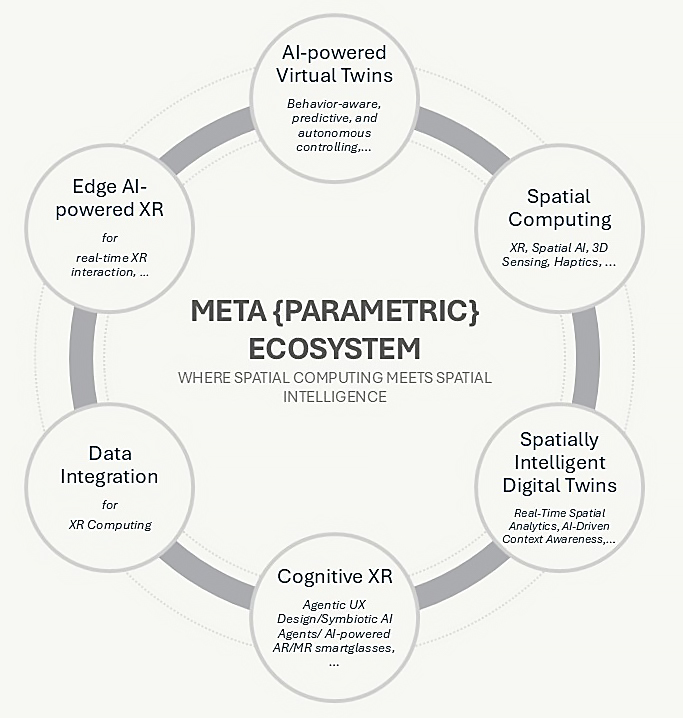
Meta{Parametric} Ecosystem
The Meta{Parametric} Ecosystem represents a visionary framework for designing intelligent, immersive, and adaptive spatial experiences. At its core is the convergence of AI, XR, spatial computing, and real-time data integration—enabling environments that are not only visualized but sensed, interpreted, and co-created. From AI-powered virtual twins and cognitive XR to edge-based interaction and symbiotic AI agents, each component contributes to a seamless, multimodal interface between humans and their digitally-augmented surroundings. This ecosystem defines a new paradigm for architectural intelligence, where Intelligent Spatial Design becomes a dialogue between data, machines, and human cognition.
In the near future, we can see extraordinary breakthroughs emerging at the intersection of AI, AR, cognitive science, neuroscience, wearable technology, and agentic AI. As spatial computing platforms evolve, the integration of intelligent AR systems with brain–computer interfaces, attention tracking, and emotion-aware AI agents could revolutionize the way architects and urban designers work. Picture smart glasses that not only visualize real-time data but also understand the user’s cognitive state, adapt to design intent, and offer proactive, voice-driven remote assistance—blurring the boundary between the human mind and machine intelligence. Such systems may one day enable fully immersive, emotionally responsive environments and intelligent design collaborations that redefine the future of the built environment.
Imagine…
Emotionally responsive environmentsthat adjust lighting, acoustics, or layouts based on your physiological state, tracked via AI.
AR glassesthat know your environment and your goals—offering real-time guidance and safety alerts through context-aware AI.
Digital twinsthat sense structural stress, predict urban flows, or coordinate autonomous systems—thinking spatially at every scale.
Cognitive XR platforms where voice-driven agents help you sketch and iterate in 3D space—bridging the gap between mind and material.
WHAT WE OFFER [currently]:
Immersive Technology Solutions
Immersive Virtual Reality Learning Environments — Interactive VR platforms tailored for architecture and engineering education.
Immersive VR Decks & Rooms — High-fidelity virtual spaces for architectural and urban design presentation, exploration, and critique.
Immersive XR Platforms for Digital Twin Visualization — Real-time, cross-device experiences of digital replicas.
360° Virtual Tours— Fully navigable tours for real estate, museums, campuses, and heritage sites.
Immersive Remote Assistance Platforms — AR/MR solutions for real-time remote support, maintenance, and hands-free system control.
Custom VR Lobby and Reception Environments — Branded, interactive virtual welcome spaces for organizations and events.
Head-Mounted Display & PC-Powered VR Application Development — High-performance VR apps optimized for Meta Quest, HTC Vive, etc.
Cross-Platform Augmented Reality Applications — Web, Android, and iOS AR apps for marketing, education, and immersive real-world interaction.
Conferences, Seminars & Training Workshops
XR Workshops & Seminars – Hands-On Learning in Digital Twins, Immersive Design & Spatial Computing
Conference & Academic Training – Specialized Tutoring for Institutions, Labs, and Think Tanks
CTO/CIO Advisory & Consultancy
Innovation Strategy for the C-Suite – Aligning Technology with Vision, Resilience & Growth
Agile Change Management & Innovation Portfolios – Structured Digital Transformation for Enterprises
Smart City Governance – Urban Tech Frameworks for Citizen-Centric, Data-Driven Development
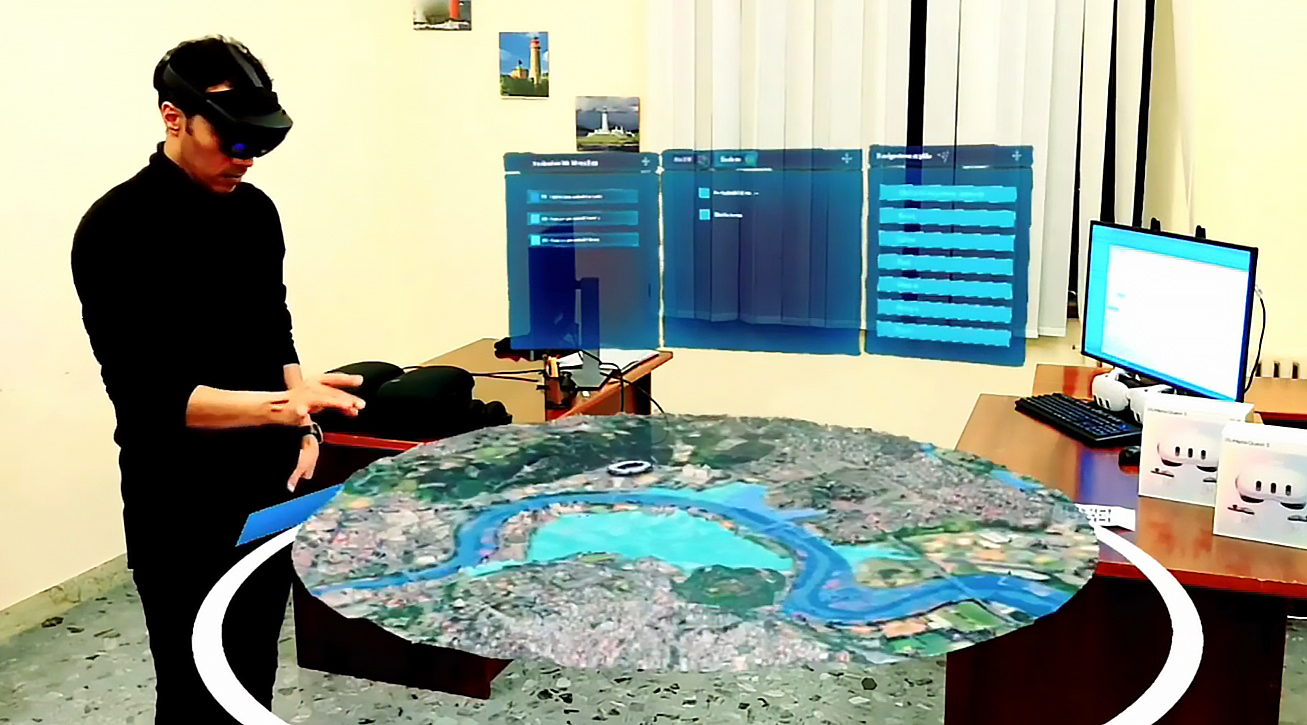
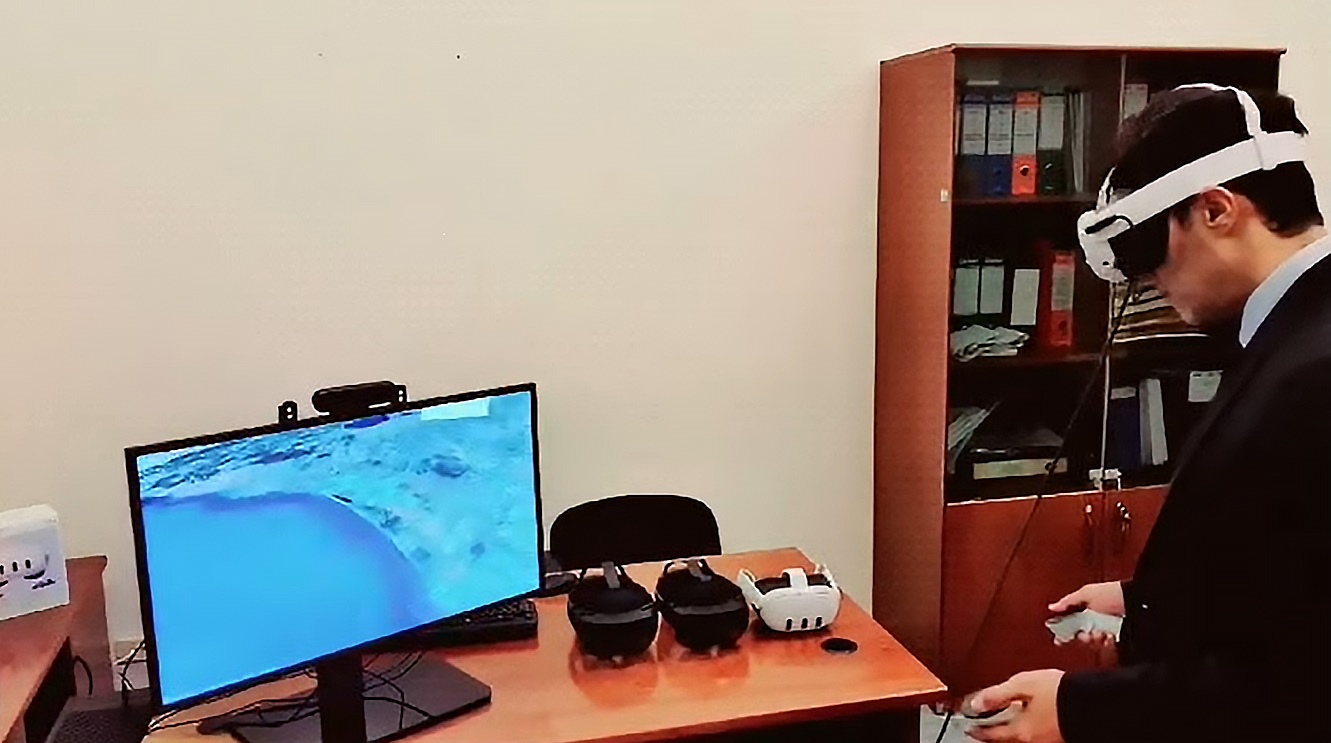
Prototyping a Mixed Reality Digital Twin Application with Microsoft HoloLens 2 Key tools/software: Unity, ArcGIS Pro, Cesium, Photon PUNPrototyping a Virtual Reality Digital Twin Application with Meta Quest 3 Key tools/software: Unity, ArcGIS Pro, Cesium
UPCOMING EVENTS
Seminar:IEEE Conferenceon Virtual Reality and 3D User Interfaces- Orlando, Florida USA; March 2024
Seminar: Web-based Digital Twin Planforms Universidad Politécnica de Madrid (Caminos UPM); March 2025
Workshop Series (6 sessions): Shahid Beheshti University (VRLab)-Tehran; August-September 2025; [Canceled]
Conference:DIWA Autumn Biannual Meeting at Aalto University – Espoo; November 2025
CONTACT US
We would be delighted to provide you with more information. Kindly reach out to the appropriate department for your inquiries:
General Inquiries:contact@metaparametric.com
Business & Partnership Opportunities:business@metaparametric.com